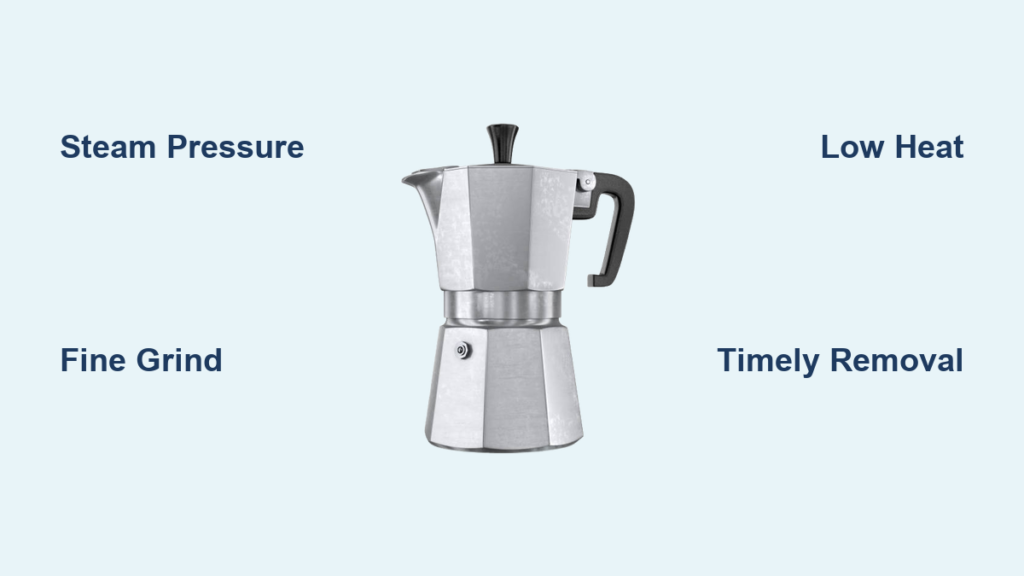
That rich, aromatic coffee filling your kitchen isn’t from a $500 machine—it’s bubbling up from a simple aluminum pot on your stovetop. Millions swear by the Italian coffee maker (properly called a Moka pot) for strong, espresso-like coffee without electricity. But how does this iconic 80-year-old design actually work? If your morning brew comes out bitter, watery, or worse—burns your coffee—you’re not alone. Understanding the precise physics behind this stovetop marvel transforms frustrating results into perfect cups. You’ll discover why water pressure replaces pumps, how steam creates the signature “gurgle,” and why grinding matters more than you think. This guide breaks down the exact science so you can troubleshoot issues and master authentic Italian coffee at home.
Moka Pot Physics: Steam Pressure vs. Gravity Extraction
Italian coffee makers operate on fundamental thermodynamics—not complex electronics. Unlike drip brewers relying on gravity, the Moka pot uses steam pressure buildup to force water through coffee grounds. Here’s what happens inside when heat meets water:
- Water chamber heating: Cold water fills the bottom chamber below a perforated filter basket holding coffee grounds.
- Steam generation: As the chamber heats, water temperature rises past 100°C (212°F). The confined space traps steam, increasing internal pressure.
- Pressure differential: Pressure in the sealed chamber exceeds atmospheric pressure by 1-2 bars (15-30 PSI)—enough to push water upward.
- Forced extraction: Pressurized hot water travels through the coffee grounds in the filter basket, dissolving oils and compounds.
- Collection phase: The brewed coffee exits through a spout into the upper chamber, signaled by characteristic gurgling sounds.
Critical visual cue: Watch for the first dark liquid emerging from the spout. If it’s pale yellow (“blonding”), your grind is too coarse or heat too low. Rich, syrupy coffee indicates optimal extraction.
Why This Isn’t True Espresso (But Tastes Better to Many)
While often called “stovetop espresso,” Moka pots operate at 1-2 bars of pressure versus the 9 bars in commercial espresso machines. This lower pressure creates a distinct profile:
– Less crema (the golden foam on espresso)
– Smoother body without espresso’s intense bitterness
– Higher caffeine concentration than drip coffee
The result? A robust, full-bodied coffee that Italians call caffè—not espresso—but satisfies espresso lovers seeking simplicity.
Moka Pot Anatomy: What Each Component Actually Does

Your 3-part aluminum pot contains engineered precision. Never disassemble without understanding these roles:
Water Chamber: The Pressure Engine
- Critical design feature: Narrow neck below the filter basket concentrates pressure
- Safety valve: Releases excess pressure if blocked (never force-closed!)
- Fill line rule: Water must stay BELOW the valve stem—overfilling causes weak coffee and safety risks
Filter Basket & Gasket: The Extraction Heart
- Perforation pattern: Laser-cut holes create even water distribution (avoid poking holes!)
- Rubber gasket: Creates airtight seal between chambers—replace when hardened or cracked
- Coffee dosage: Fill basket level—never tamp! Compacting blocks water flow causing bitter over-extraction
Upper Chamber: Collection & Temperature Control
- Conical shape: Directs coffee away from heat source to prevent scorching
- Cooling ring: Aluminum lip dissipates heat as coffee enters
- Spout design: Angled to stop drips and signal brewing completion via sound changes
Pro tip: Aluminum models conduct heat faster than stainless steel, but require hand-washing to prevent oxidation. Never use on induction stoves without a converter disk.
Step-by-Step Brewing Process: Timing Is Everything
Follow this sequence for flawless coffee—deviate by 15 seconds and flavor changes dramatically:
- Prep water chamber: Fill with cold filtered water to just below the safety valve
- Grind coffee: Use fine espresso grind (like table salt)—too coarse = sour coffee, too fine = bitter sludge
- Load filter basket: Gently spoon grounds—no tamping—level with rim
- Assemble carefully: Screw top chamber on by hand only (overtightening cracks gaskets)
- Apply LOW heat: Medium-low on gas, lowest setting on electric—never boil violently
- Watch the spout: First dark drops appear at 45-60 seconds; rich flow continues for 20-30 seconds
- Remove immediately: When gurgling slows and coffee lightens, place pot on cold surface
Time-saving hack: Preheat water chamber with hot tap water to cut brewing time by 25%—but never use boiling water (creates steam pockets that block flow).
Why Your Coffee Overflows or Tastes Bitter
These common failures trace directly to physics violations:
- Overflowing coffee: Heat too high → rapid steam buildup → water erupts through coffee grounds
- Sour weak coffee: Water not hot enough → insufficient pressure → under-extraction
- Bitter burnt taste: Residual heat continues brewing after removal → over-extraction
- No coffee flow: Clogged filter holes or overfilled water chamber blocking valve
Fix immediately: Reduce heat 30 seconds after assembly if water flows too fast. If coffee stalls, briefly lift pot off heat to reset pressure.
Optimizing Your Brew: The 3 Non-Negotiable Variables

Master these elements before tweaking recipes:
| Variable | Correct Setting | Consequence of Error |
|---|---|---|
| Grind Size | Fine (0.3-0.5mm) | Coarse: Weak/sour; Fine: Bitter/slow |
| Heat Level | Medium-low (simmer) | High: Burnt/overflow; Low: Weak/long brew |
| Coffee Dose | Level basket (no tamp) | Overfilled: Blocked flow; Underfilled: Watery |
Water temperature secret: 92-96°C (198-205°F) is ideal. Boiling water (100°C+) scalds coffee oils. Use this trick: Start with warm tap water (50°C/122°F) to hit perfect temp as brewing completes.
Maintenance Mistakes That Destroy Your Moka Pot
Most “broken” Moka pots suffer from preventable neglect:
- Wrong cleaning method: Dishwasher use warps aluminum and degrades gaskets—always hand-wash with cool water
- Gasket neglect: Cracked seals cause pressure leaks—replace yearly or when coffee takes >90 seconds
- Mineral buildup: Hard water clogs filter holes—descale monthly with equal parts water/vinegar
- Forced assembly: Cross-threading cracks chambers—screw straight by hand only
Critical warning: Never leave an empty Moka pot on heat. Aluminum warps at 200°C (392°F), ruining the seal permanently.
Why Modern Espresso Machines Can’t Replicate This
Despite technological advances, the Moka pot’s charm lies in its elegant constraints:
– Thermal inertia: Aluminum heats/cools faster than commercial group heads, preventing scorching
– Natural pressure curve: Steam builds gradually then drops—unlike espresso’s constant 9-bar pump
– No electricity dependency: Works during power outages or camping trips
Baristas confirm: The Moka pot’s 1.5-bar pressure extracts more nuanced chocolate and caramel notes than high-pressure espresso machines, which emphasize acidity.
Troubleshooting Flowchart: Fix Brews in 60 Seconds

When coffee fails, diagnose using this sequence:
mermaid

graph TD

    A[Coffee too weak?] -->|Yes| B[Grind finer?]

    A -->|No| C[Bitter coffee?]

    C -->|Yes| D[Reduce heat immediately]

    C -->|No| E[No coffee flow?]

    E -->|Yes| F[Check water level below valve]

    F -->|Still blocked| G[Clean filter holes with toothpick]

    D -->|Still bitter| H[Shorten brew time by 10 sec]

    B -->|Still weak| I[Increase coffee dose 10%]
Preserving Authentic Italian Flavor Long-Term
Extend your Moka pot’s life and flavor quality with these pro habits:
– Season new pots: Brew 2-3 plain water cycles before first use to remove manufacturing oils
– Store disassembled: Prevents gasket compression and moisture buildup
– Avoid soap residue: Rinse thoroughly—soap film ruins coffee’s delicate oils
– Revive aluminum: Scrub with baking soda paste to remove oxidation stains
Final pro tip: For true Italian caffè, serve immediately in preheated cups—never let coffee sit in the upper chamber. The moment brewing stops, extraction continues from residual heat.
Mastering the Moka Pot Means Mastering Physics
Your Italian coffee maker isn’t just a nostalgic kitchen tool—it’s a precision instrument harnessing steam pressure, temperature gradients, and fluid dynamics. By respecting its engineering limits (low heat, correct grind, timely removal), you unlock intense, aromatic coffee that modern machines often over-engineer. Remember: the gurgle isn’t a flaw—it’s physics confirming perfect pressure. When your first dark syrupy stream emerges, you’re witnessing thermodynamics transformed into tradition. Now that you know how does an italian coffee maker work, that simple aluminum pot becomes your most powerful brewing ally. For deeper mastery, experiment with grind sizes using this rule—adjust one variable at a time while keeping water temperature and heat constant. Your perfect cup is simmering just below the surface.