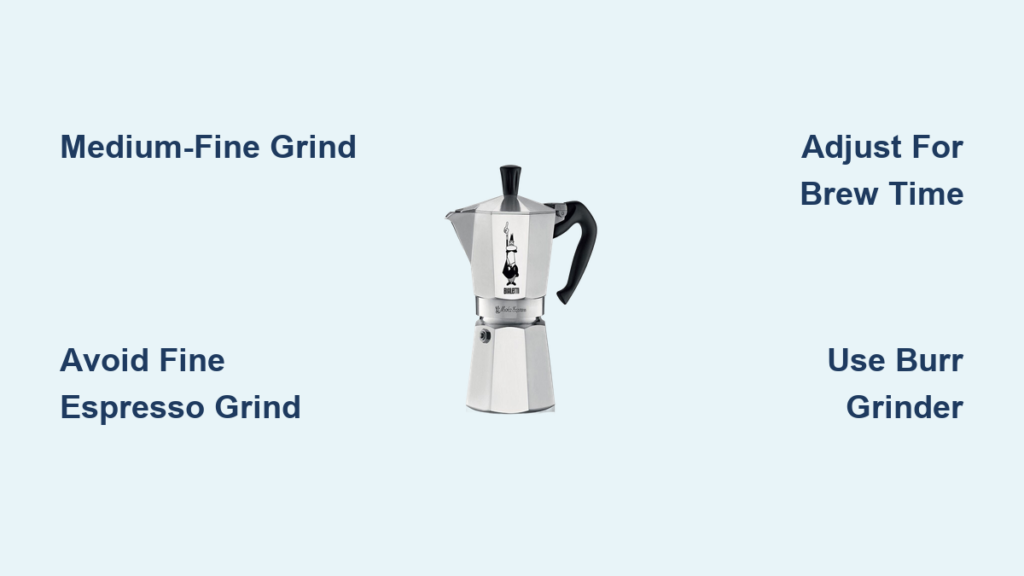
Your Bialetti moka pot sits on the stove, ready to brew, but something’s off. The coffee either rushes through too quickly leaving weak, watery espresso or struggles to emerge at all, creating bitter, over-extracted sludge. The culprit? Your coffee grind size. Getting the grind right for your Bialetti is the make-or-break factor between café-quality espresso and disappointing results. Unlike standard drip coffee makers, Bialetti moka pots require a very specific grind that falls between what you’d use for pour-over and traditional espresso. In this guide, you’ll discover exactly how to grind coffee for Bialetti to achieve that rich, velvety crema and balanced flavor your Italian coffee maker was designed to produce.
Why Your Bialetti Needs a Specific Grind Size
Bialetti moka pots operate under moderate pressure (about 1-2 bars) compared to commercial espresso machines (9 bars), which means they require a different grind profile. The traditional Bialetti design with its aluminum construction and three-chamber system demands a medium-fine grind that allows proper water flow while still creating enough resistance to develop flavor. When the grind is too coarse, water rushes through without properly extracting the coffee’s oils and compounds, resulting in thin, sour coffee. Too fine, and you’ll experience excessive pressure buildup that can cause dangerous steam release or bitter, muddy coffee with sediment in your cup. The sweet spot for Bialetti grind size resembles fine beach sand—more granular than table salt but finer than standard drip coffee.
How Bialetti Brewing Mechanics Dictate Grind Requirements
The unique three-chamber design of Bialetti moka pots creates specific pressure dynamics that directly impact your required grind size. As water in the bottom chamber heats, steam pressure forces it through the coffee puck in the middle basket and up through the top chamber. This process requires precise resistance: too little resistance (coarse grind) means the water passes through too quickly without proper extraction, while too much resistance (fine grind) creates dangerous pressure buildup that can compromise the safety valve. Your grind size directly controls this critical balance point.
What Happens When You Use the Wrong Grind Size
Using an incorrect grind size for your Bialetti creates immediate, noticeable problems. With too coarse a grind, your coffee brews in under 30 seconds, producing pale, weak coffee with prominent sour notes as only the most soluble compounds extract. Conversely, too fine a grind causes brewing times exceeding 2 minutes, resulting in dark, bitter coffee with visible sediment and potential safety concerns as pressure builds beyond the valve’s capacity. Many users mistake these issues for broken equipment when the solution lies entirely in proper grind adjustment.
Achieving the Perfect Bialetti Grind Size

The ideal grind for Bialetti resembles granulated sugar with some slightly finer particles—more consistent than standard drip coffee but not as powdery as true espresso. This medium-fine texture creates optimal extraction within the 45-90 second ideal brewing window for moka pots. When properly ground, your coffee should feel slightly gritty between your fingers but not leave a dusty residue. The particles should be uniform enough that when you pour them, they flow with a moderate pace—not as free-flowing as coarse drip grind nor as clumpy as espresso.
How to Adjust Your Grinder for Bialetti Specifications
Most blade grinders lack the precision needed for consistent Bialetti results, making burr grinders the superior choice. For conical burr grinders, start at setting #5 on a 1-10 scale (where 1 is finest) and adjust based on results. With flat burr grinders, begin at the espresso setting minus one notch. The key adjustment principle: if your brew time exceeds 90 seconds or you notice bitter flavors, coarsen the grind slightly; if brew time is under 45 seconds with sour notes, go finer. Always make micro-adjustments—one click at a time—and allow the grinder to settle before evaluating results.
Visual and Tactile Indicators of Proper Grind
Your perfect Bialetti grind should pass three simple tests: First, when pinched between fingers, it should feel gritty with no powdery residue (unlike espresso). Second, when poured from your hand, it should flow steadily but not as freely as coarse drip grind. Third, when examining a sample under bright light, you should see mostly uniform particles the size of fine sand with minimal fines (dust) or boulders (large chunks). Avoid the “table salt test” myth—real table salt is actually finer than ideal Bialetti grind.
Step-by-Step Grinding Process for Bialetti
Preparing Your Grinder for Optimal Results
Before grinding, ensure your grinder is clean and at room temperature, as residual heat from previous sessions affects grind consistency. Measure your coffee beans using a scale (1:7 coffee-to-water ratio is ideal for Bialetti), then purge your grinder by running a small amount of beans through to clear old grounds from the burrs. For best results, grind in small batches—no more than what you’ll use for two Bialetti brews at once—to maintain consistent particle size.
Executing the Perfect Grind for Bialetti
Start with a medium-fine setting as your baseline. Grind your measured beans in short pulses rather than one continuous grind to prevent heat buildup. Immediately after grinding, gently shake the grounds to settle them, then use a spoon to lightly level them in the portafilter without tamping. Properly ground coffee for Bialetti should sit loosely in the basket with visible air gaps between particles—never compacted. The entire grinding process should take no more than 30 seconds to minimize oxidation.
Troubleshooting Common Grind Issues During Brewing
If your Bialetti brews too quickly (under 45 seconds), the coffee will taste sour and weak—immediately coarsen your grind by one setting for the next brew. When extraction takes over 90 seconds with bitter, dark coffee, your grind is too fine; adjust one notch coarser. If you notice inconsistent extraction (some parts strong, some weak), your grind lacks uniformity—clean your grinder burrs or consider a higher-quality grinder. Never tamp the coffee in your Bialetti basket; simply level it with a gentle tap.
Essential Tools for Perfect Bialetti Grind

Must-Have Grinder Features for Bialetti Success
Not all grinders deliver the consistency Bialetti requires. Look for burr grinders with stepless adjustment for micro-tuning, preferably with conical burrs that produce less heat. A quality grinder should maintain particle consistency within 100 microns across the entire batch. Avoid grinders with only 5-10 adjustment settings—aim for at least 15 steps for proper control. The Baratza Encore and 1ZPresso Q2 are excellent entry-level options that provide the precision Bialetti demands.
Alternative Grinding Methods When You Lack Equipment
Without a proper burr grinder, you have limited but workable options. A high-quality manual burr grinder like the Hario Skerton Pro can deliver acceptable results with careful adjustment. Electric blade grinders can work with the “pulse and shake” technique—pulse 5 seconds, shake, repeat 8-10 times—but expect inconsistent results. Never use pre-ground coffee marketed for espresso; it’s typically too fine for Bialetti. If absolutely necessary, grind coarse coffee beans in a blender using short bursts, though this produces highly inconsistent results.
Maintaining Consistent Grind Quality Over Time
Regular Grinder Maintenance for Bialetti Performance
Your grinder’s performance degrades without proper care, directly impacting your Bialetti results. Clean burrs monthly using a grinder cleaning brush and specialized cleaning tablets to remove coffee oil buildup that causes inconsistent grinding. Replace burrs every 500-750 pounds of coffee to maintain precision. After each use, purge the grinder with a small amount of beans to clear residual grounds that might stale and affect next brew’s flavor.
Environmental Factors Affecting Grind Consistency
Humidity dramatically impacts coffee grinding—beans become more brittle in dry conditions and gummy in humid environments, altering your effective grind size. Store beans in an airtight container with a one-way valve, but grind immediately before brewing for best results. If you live in a humid climate, you may need to grind slightly finer than usual; in dry climates, go slightly coarser. Always adjust based on actual brew performance rather than fixed settings.
Final Tips for Perfect Bialetti Coffee Every Time
Use freshly roasted beans (within 2-4 weeks of roast date) for optimal flavor development. Preheat your Bialetti with hot water to reduce thermal shock and stabilize brewing temperature. Never fill the water chamber past the safety valve, and always brew over medium-low heat to control pressure buildup. After brewing, immediately separate the top and bottom chambers to prevent over-extraction from residual heat. Most importantly, trust your taste buds over timers—perfect Bialetti coffee should have balanced acidity, full body, and a thin layer of golden crema on top. With consistent grind size as your foundation, you’ll transform your daily Bialetti ritual into a reliable source of exceptional coffee.